
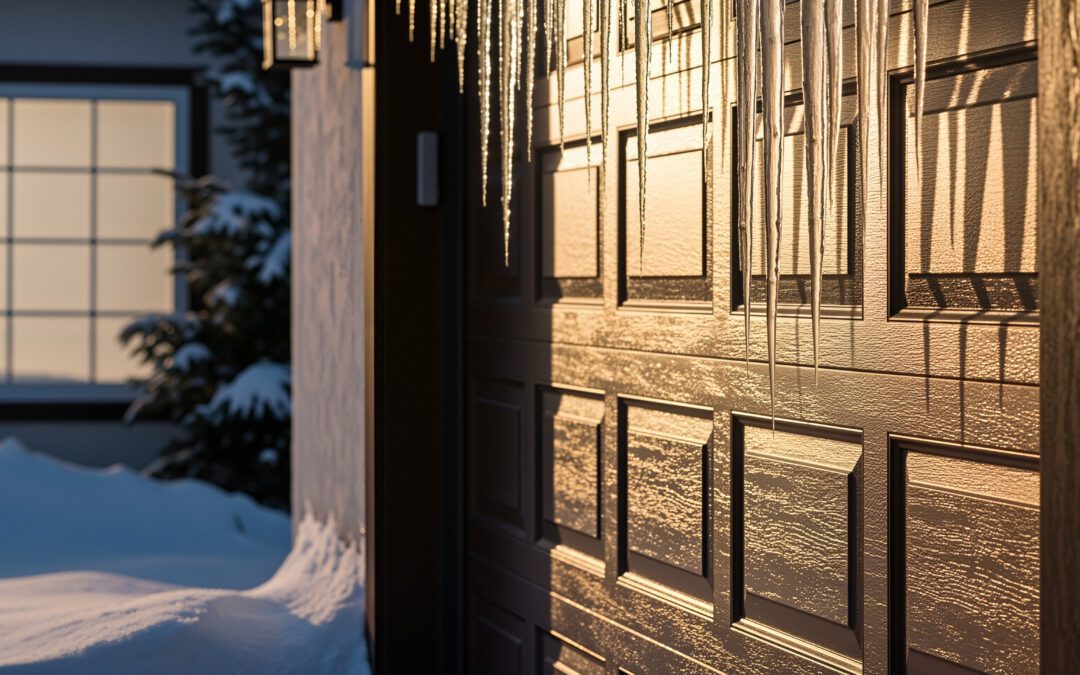
If you have ever opened the garage door after a long, cold snap and found a curtain of ice hanging over the opening, you already know the problem. Icicles look harmless until they land where you park, walk, and shovel.
They can also bend gutters, rip downspouts loose, and turn a normal thaw into a slick, refreezing mess along the driveway. If you keep seeing icicles on gutters above your garage door every winter, you are not alone.
We wrote this guide to do two things:
- Help you understand why icicles form where they do, especially along garages.
- Show how a properly designed seamless gutter system can reduce icicles in most conditions by keeping meltwater moving and keeping drainage paths clear.
We will keep this practical. We will not tell you to climb a ladder and start hacking at ice. We will also separate what gutters can control from what belongs in the attic and roof assembly. If you want the deeper “fix the cause” winter plan, we lay that out in our winter maintenance guide.
Why Icicles Form at Roof Edges
Icicles form when meltwater drips from a roof edge and refreezes in cold air. The key detail is the word “meltwater.” If the roof never melts, there is nothing to drip. Building science guidance explains that ice dams and edge ice occur when the roof deck is warm enough to melt snow while the eave stays cold enough to refreeze it. We like Building Science Corporation’s plain-language digest on ice dam causes and solutions because it does a good job separating roof assembly fixes from short-term winter fixes.
Air leaks and thin insulation are common reasons the roof surface warms unevenly, though solar melt can contribute, too. For Maine-specific weatherization guidance, Efficiency Maine’s overview of attics, roofs, ducts, and vents is a solid starting point.
That means icicles are often a symptom. They can show up with a full ice dam, or they can show up as a smaller edge-ice problem that still creates hazards at doors and walkways.
Our focus in this post is on what happens after melting starts. Once water is moving, the goal is to keep it moving. That is where gutters, outlets, downspouts, and discharge planning matter.
Why Garages Get Bigger Icicles than the Rest of the House
When homeowners call us about icicles, the garage is the most common trouble spot in our experience. If you are dealing with icicles on the edges of your garage year after year, you are seeing a pattern we can usually diagnose.
Garage Rooflines Concentrate Meltwater
Garages often sit under roof transitions. The main roof may dump into a valley that ends right at the edge of the garage. Even a small amount of melt up-slope becomes a steady drip at the garage eave, and repeated drip-freeze cycles create long icicles.
Garages Have More Temperature Swings
Many garages are unheated or only lightly heated, but they are attached to a heated living space. If there is a room above the garage, the floor and ceiling planes around that space can be drafty. Warm air leaking from the home can warm parts of the roof deck above the garage, melting snow higher up, and feeding the drip line at the edge.
The Garage Edge Is Over Hard Surfaces
Even if a home has icicles elsewhere, they become a bigger problem at the garage because they hang over a driveway, a door opening, and the spot where you walk with your hands full. The discharge point is often a paved area where water refreezes instead of soaking into the soil.
Downspouts Get Buried and Freeze Shut
A very practical reason garages develop the worst icicle buildup is snow management. Driveway snowbanks and plow berms often bury downspout elbows and splash zones. If the bottom of the downspout is blocked by snow and ice, meltwater has nowhere to go. It backs up, slows down, and refreezes into thicker edge ice and larger icicles.
If you see icicles at the garage but not elsewhere, or if you only see icicles on garage corners and valleys, that pattern often points to a local drainage bottleneck: a valley, a long run feeding one outlet, a buried downspout, or a low spot in the gutter line.
Dangerous Icicles: the Risks Homeowners Underestimate
Icicles are more than a nuisance. Medical guidance warns that falling ice can cause serious injuries, including concussions and broken bones, and that the risk increases when people try to remove icicles while standing on ladders in winter. The Cleveland Clinic explains the risk and why ladder removal is a bad idea in their article on dangerous icicles. The safest move is to keep people out from under the drop zone and call for professional help when the buildup is large.
There is a property risk, too. When large icicles release, they can bend gutters out of pitch, pull on end caps and corners, and stress downspout outlets. That damage can turn one winter hazard into a spring overflow problem.
If you remember one thing from this section, let it be this: dangerous icicles are a signal to prioritize safety first. When we see dangerous icicles over a garage door, we treat it as both a safety hazard and a drainage clue that needs attention.
How Seamless Gutter Systems Reduce Icicles in Most Conditions
We cannot promise that any gutter system will stop every icicle in every winter. Still, if your goal is to prevent icicles from becoming a recurring hazard over the garage door and driveway, the right drainage design makes a real difference. The root cause is still meltwater, and meltwater is driven by roof temperature. What we can do is reduce the ways that meltwater gets stuck, slows down, and refreezes at the edge.
Here are the most reliable ways a well-designed seamless system helps.
Fewer Seams Means Fewer Freeze Plugs
Sectional gutters have joints along the run. Those joints can catch grit and debris, and they are natural places for ice to form first. Seamless gutters are formed in continuous runs, which reduces snag points and makes it easier for water to reach the outlet before it refreezes. This is one reason seamless systems perform well in Maine’s freeze-thaw cycles.
Better Pitch Control Reduces Standing Water
A gutter that holds water becomes a steady source of icicles. If the line has a low spot, water pools, freezes, and forces the next melt to run around or over the ice. During installation, we set a consistent pitch toward the outlet and support the line so it holds that pitch under snow load. This keeps meltwater moving instead of sitting at the lip and feeding drip lines.
Outlet Placement and Downspout Routing Matter More Than Most People Think
Garages often have long, uninterrupted runs. If all that water has to travel to one outlet at the far end, it is more likely to back up during heavy melt. In many cases, adding capacity is more effective than adding heat. That can mean an extra outlet, a better downspout location near a valley, or a downspout plan that avoids dumping water onto the driveway.
Guards and Fall Cleaning Reduce the “Ice Plus Debris” Trap
Fine debris and roof grit are winter problems because they help form freeze plugs at outlets. If you are under pines, needles and grit can create a mat that holds water right where it freezes first. The fix is usually simple: clean before winter, and consider a guard system that matches your tree cover and roof grit. Stainless micro-mesh guards can reduce debris buildup in many pine-heavy situations, but they still need occasional rinsing.
If you want the full guide, see our gutter guards guide, and if you want the bigger winter order of operations, start with our winter maintenance guide.
Strong Fastening Keeps the System from Sagging into New Low Spots
Snow and ice add weight. If the gutter line flexes, pitch changes and new low spots form. That is why fastening and hanger spacing are part of winter performance, not just appearance. If you want the homeowner version of what we look for, read our post on hanger spacing for snow and wind. A stable line drains more completely, which means fewer places for water to refreeze into icicles.
Where Icicles on Gutters Are Most Prevalent in Maine
Icicles do not form evenly. They form in patterns. When icicles on gutters keep returning in the same locations, it usually points to one repeatable bottleneck we can fix.
Here are the most common locations we see:
- Over garage doors and main entry doors, especially where a valley dumps onto the eave.
- Along shaded north-facing eaves that stay colder during daytime thaws.
- At the ends of long runs, where water backs up before reaching the outlet.
- At corners and end caps, where small drips feed repeated freeze lines.
- At downspout elbows near grade, especially when snowbanks block discharge.
- Beneath dormers and roof transitions that concentrate meltwater.
If the icicles are thickest at the downspout, suspect a frozen or buried discharge. If they are thickest mid-run, suspect a low spot or a debris trap. If they are thickest under a valley, suspect a concentrated meltwater source that needs more outlet capacity.
What to Do If You Have Icicles Right Now
If you already have icicles, start with safety and simple ground-level steps.
- Create a no-walk zone beneath the icicles. Keep kids, pets, and visitors out from under the drop area.
- Do not climb a ladder on icy ground to knock them down. Medical advice is clear that winter ladder work is high risk.
- Look at the downspout discharge area. If a snowbank is burying the outlet, clear that area back so water has somewhere to go.
- If you have an extension, confirm it is not frozen into place or clogged with ice.
- After the next thaw, watch where water flows. If you see water spilling over the gutter edge, you may have a frozen outlet, a clog, or a low spot holding ice.
If the buildup is large or over a high-traffic area, call for professional help. Ice removal can be dangerous, and damage can happen quickly when ice releases. The safest plan is usually to remove the hazard, then fix the cause before the next freeze-thaw cycle.
Ready to Reduce Garage Icicles with a Winter-Ready Seamless System?
If your garage eave is the one that always grows the biggest icicles, we can help you build a plan that addresses both the drainage details and the underlying winter conditions.
Start with our Services page to see how we approach seamless installation, cleaning, and guards. Then use our winter maintenance guide as your checklist for reducing freeze plugs and keeping meltwater paths open. If you want a quick primer on why seamless gutters are built for Maine weather, we also break that down in our post on why seamless gutters are perfect for Maine weather.
When you are ready, schedule a free estimate. We will map the garage roofline, note any valleys and long runs, evaluate outlet and downspout capacity, and recommend changes that reduce the conditions that create dangerous icicles in the first place.
Recent Comments